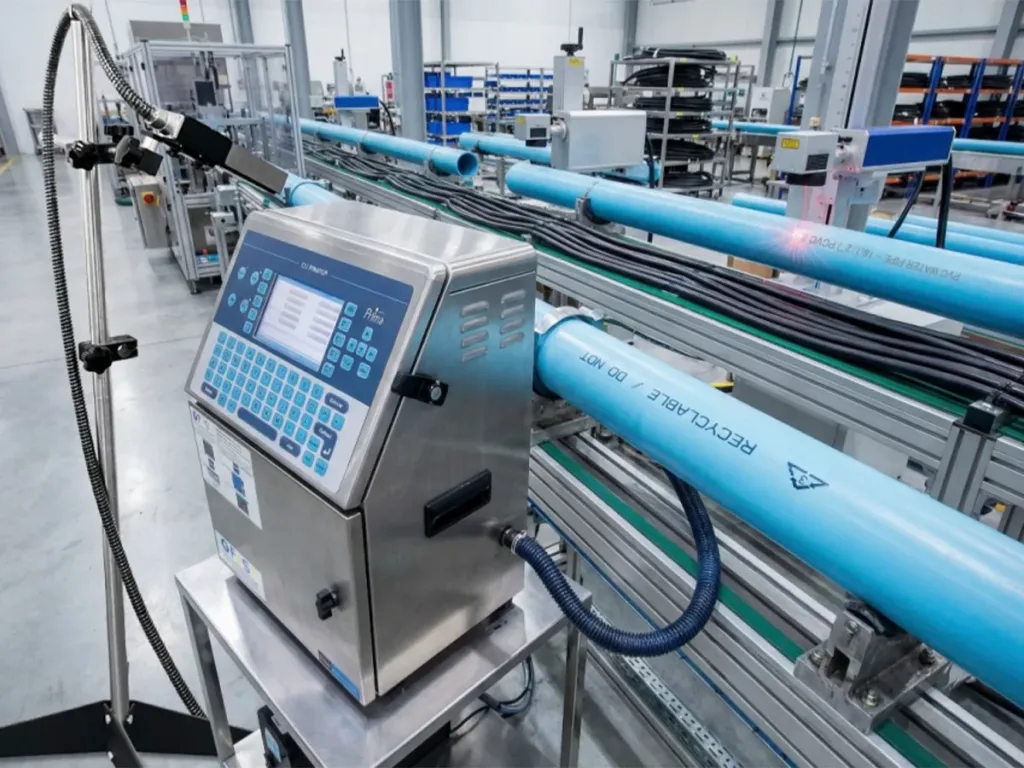
The performance of marking and coding solutions on wire, cable and pipe industries needs to match the realities of the production process. Coder downtime that stops the extrusion process can result in expensive downtime, rework and scrap. Poor code contrast or quality and ink transference are further challenges that can degrade the quality of your product. We have extensive application expertise and a range of solutions that address these challenges to help maximize the productivity of your operations.
Key Challenges in Marking Extrusions
Coding and marking solutions in this sector must overcome several unique challenges:
High Production Speeds:
Marking systems must apply clear, legible codes while the product is being extruded at very high linear speeds.
Curved and Uneven Surfaces:
The equipment must maintain print quality on round, flexible, and variable-diameter substrates.
Substrate Variability:
Inks and lasers must be formulated or calibrated to adhere to and contrast against a wide range of materials (e.g., dark rubber, light PVC, polished metal, rough concrete).
Code Durability:
The markings must resist ink transfer (smudging) as the product is reeled or bundled, and must remain legible for the product’s lifespan, withstanding abrasion, heat, and environmental exposure.
Two main Technologies in Wire, Cable and Pipe Industries
1.Continuous Inkjet (CIJ) Printing
This is the most common non-contact marking method for high-speed extrusion lines.
Function:
The machine ejects a continuous stream of electrically charged ink droplets, which are deflected by an electric field to form characters directly onto the moving surface.
Suitability:
Wire, Cable, and Plastic Pipe.
Key Benefit:
Exceptional speed (up to 1,000 meters per minute) and ability to print on flexible, uneven, and curved surfaces without contact. Specialized inks are used for high adhesion, contrast (often pigmented white or yellow ink), and resistance to oil, water, and solvents.
2.Laser Marking Systems
Laser technology provides a highly durable and chemical-free marking solution.
Function:
A focused laser beam interacts with the material to create a mark. This can involve ablation (removing a layer), foaming (creating a raised, light-colored mark), or etching (engraving the surface).
- CO2 Lasers: Best for marking PVC and plastics by creating a gold-colored or high-contrast mark.
- Fiber Lasers: Used for marking metals and some rigid plastics.
- UV Lasers: Ideal for marking delicate insulation materials (like Teflon or FEP) without damaging the substrate.
Suitability:
Wire, Cable, and Metal/Plastic Pipe.
Key Benefit:
Creates permanent codes that are highly resistant to abrasion, heat, and chemicals. Requires no consumables (ink/solvent) and is low maintenance.