



Product Description
In today’s manufacturing and packaging industries, efficient product handling is essential for maintaining productivity, reducing labor costs, and ensuring consistent processing quality. Many production operations require products to be separated from stacked piles and delivered individually to downstream equipment such as inkjet printers, laser markers, labeling machines, packaging systems, and sorting stations. Manual feeding is often inefficient, labor-intensive, and prone to inconsistencies.
Industrial Friction Feeder Systems provide a reliable and cost-effective solution for automated product separation and feeding. Designed to handle a wide variety of flat products, these systems automatically separate, transport, and present products one by one, creating a continuous and controlled production flow. By integrating feeding operations into automated production lines, manufacturers can significantly improve efficiency while reducing operator workload.
Reliable Feeding Technology for High-Volume Production
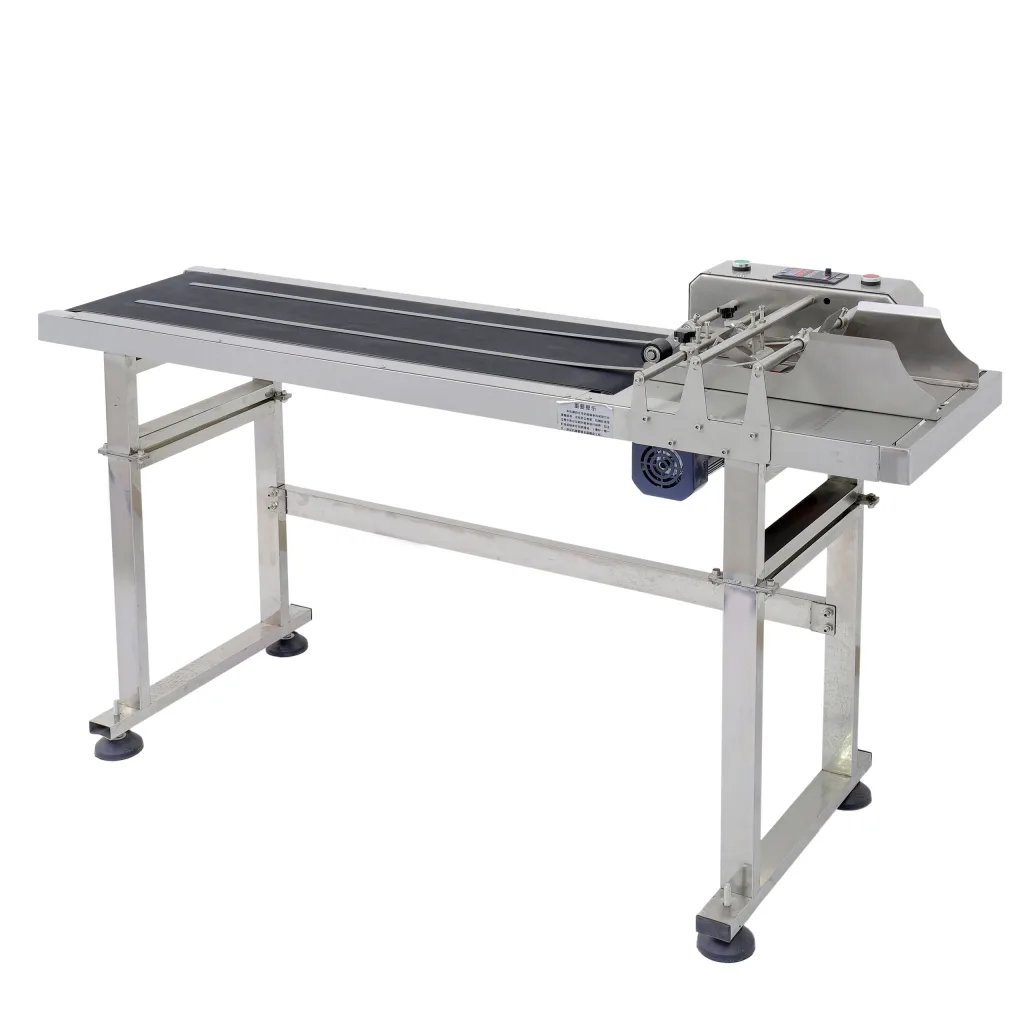
The friction feeder operates using a proven mechanical feeding principle. Products are loaded into an adjustable feeding hopper, where specially designed friction belts separate the bottom product from the stack and transfer it onto the conveyor section.
The feeding process ensures that products are presented individually with consistent spacing, allowing downstream equipment to perform accurately and efficiently. This simple yet highly effective technology has been widely adopted across numerous industries due to its reliability, low maintenance requirements, and ability to support continuous production environments.
Compared with manual feeding methods, friction feeders deliver improved consistency, higher throughput, and better process control.
Suitable for a Wide Range of Product Types
One of the key advantages of friction feeding technology is its versatility. The system is capable of handling a broad range of flat and semi-rigid products commonly used throughout manufacturing and packaging industries.
Typical applications include:
* Plastic bags
* Packaging pouches
* Paper sheets
* Labels and stickers
* Product inserts
* Instruction manuals
* Greeting cards
* Coupons and vouchers
* Cartons and folded boxes
* Pharmaceutical leaflets
* Flexible packaging materials
The feeder can be adjusted according to product dimensions, thickness, and material characteristics, providing stable separation performance across different applications.
Ideal for Coding and Marking Applications
Friction feeders are widely used in coding and marking production lines where accurate product presentation is essential.
By delivering products individually and maintaining consistent spacing, the feeder creates ideal conditions for high-quality printing and marking operations.
The system can be integrated with:
* Continuous Inkjet Printers (CIJ)
* Thermal Inkjet Printers (TIJ)
* High-Resolution Inkjet Systems
* UV Inkjet Printers
* Laser Marking Machines
* Variable Data Printing Systems
Applications include printing production dates, expiration dates, batch numbers, serial numbers, barcodes, QR codes, and traceability information on packaging materials and individual products.
Consistent feeding significantly improves coding accuracy while reducing missed prints and production errors.
Flexible Integration with Automated Production Lines
Modern manufacturing facilities increasingly require equipment that can be integrated into complete automation systems. Friction feeders are designed with flexibility in mind, allowing seamless integration with a wide range of industrial equipment.
Common production line applications include:
* Product feeding before coding stations
* Laser marking systems
* Labeling machines
* Packaging equipment
* Product counting systems
* Sorting and collection stations
* Manual inspection workstations
The modular design enables manufacturers to configure production lines according to their operational requirements while maintaining smooth product flow between processing stages.
Adjustable Speed for Different Production Requirements
Production demands vary across industries and applications. To accommodate different operating conditions, friction feeders are equipped with adjustable speed control systems.
Operators can easily synchronize feeding speed with downstream equipment, ensuring stable production flow throughout the line.
Benefits include:
* Consistent product spacing
* Improved process stability
* Reduced product overlap
* Higher production efficiency
* Better compatibility with automation equipment
Whether operating at low production volumes or high-speed manufacturing environments, the feeder can be configured to meet specific production targets.
Customizable Solutions for Different Products
Every product presents unique feeding challenges. To ensure optimal performance, friction feeder systems can be customized according to customer requirements.
Customization options include:
* Feeding width
* Conveyor length
* Working height
* Belt material selection
* Product guide rails
* Collection trays
* Speed control configurations
* Product positioning accessories
These flexible configurations allow manufacturers to integrate the feeder into existing production lines while supporting future process upgrades.
Durable Design for Industrial Environments
Industrial equipment must operate reliably under demanding production conditions. Our friction feeder systems are built using robust mechanical components and industrial-grade materials to ensure long-term performance.
Key advantages include:
* Heavy-duty frame construction
* Stable drive systems
* Easy adjustment mechanisms
* Low maintenance requirements
* Continuous operation capability
* Long service life
The durable design minimizes downtime while maximizing operational efficiency.
Improving Productivity and Reducing Labor Costs
Manual product feeding often creates bottlenecks that limit overall production capacity. Automated friction feeders eliminate these inefficiencies by providing continuous and controlled product separation.
Manufacturers benefit from:
* Increased throughput
* Reduced labor dependency
* Improved product consistency
* Enhanced process reliability
* Lower operating costs
* Greater automation capabilities
As production requirements continue to increase, automated feeding solutions become an essential part of modern manufacturing strategies.
Tailored Feeding Solutions for Modern Manufacturing
Whether processing labels, packaging materials, paper products, cartons, or flexible pouches, our friction feeder systems provide dependable and efficient product separation for a wide range of industrial applications.
With flexible configuration options, reliable feeding performance, and seamless integration capabilities, these systems help manufacturers build more productive, automated, and scalable production lines.
Designed for coding, marking, labeling, packaging, and general automation applications, our friction feeder solutions deliver the performance and reliability required for today’s fast-paced manufacturing environments.
Standard specification parameters(Machine speed and size can be customized)
| Speed | 1-80m/min |
| Rated Voltage | 220V,50-60Hz |
| Weight | 20kg |
| Total Power | Max 1000W |
| Overall Dimensions | L1550 xW400xH770mm |
Application and Selection Guidance for Automatic Friction Paging Machine for Packaging, Coding, and Labeling Applications
For industrial laser marking projects, confirm the required code content, production-line speed, substrate, print height, number of lines, installation distance, communication interface and consumable requirements against the verified specifications above. Providing sample images and line information helps INKVEO review the application and recommend an appropriate configuration.